
PCOS (Artava Kshaya) causes hormonal imbalance. Get Panchakarma treatment at AMRUT AYU CARE™ Pune. M.D. doctors with 15+ years. Book a consultation today.
|
KEY TAKEAWAYS •
Root-cause healing: Panchakarma
corrects Vata-Kapha dosha imbalance underlying PCOS •
Expert care: Treatment by M.D. Ayurveda
doctors with 12–15+ years of specialized women’s health experience •
Proven outcomes: 85% of patients report lasting
hormonal improvement within 4–8 weeks of Panchakarma •
Accessible care: 5 clinic locations across Pune
with online consultation available for outstation patients •
All-India service: Medicine
courier facility available across India for continued treatment |
What is PCOS in Ayurveda?
Polycystic
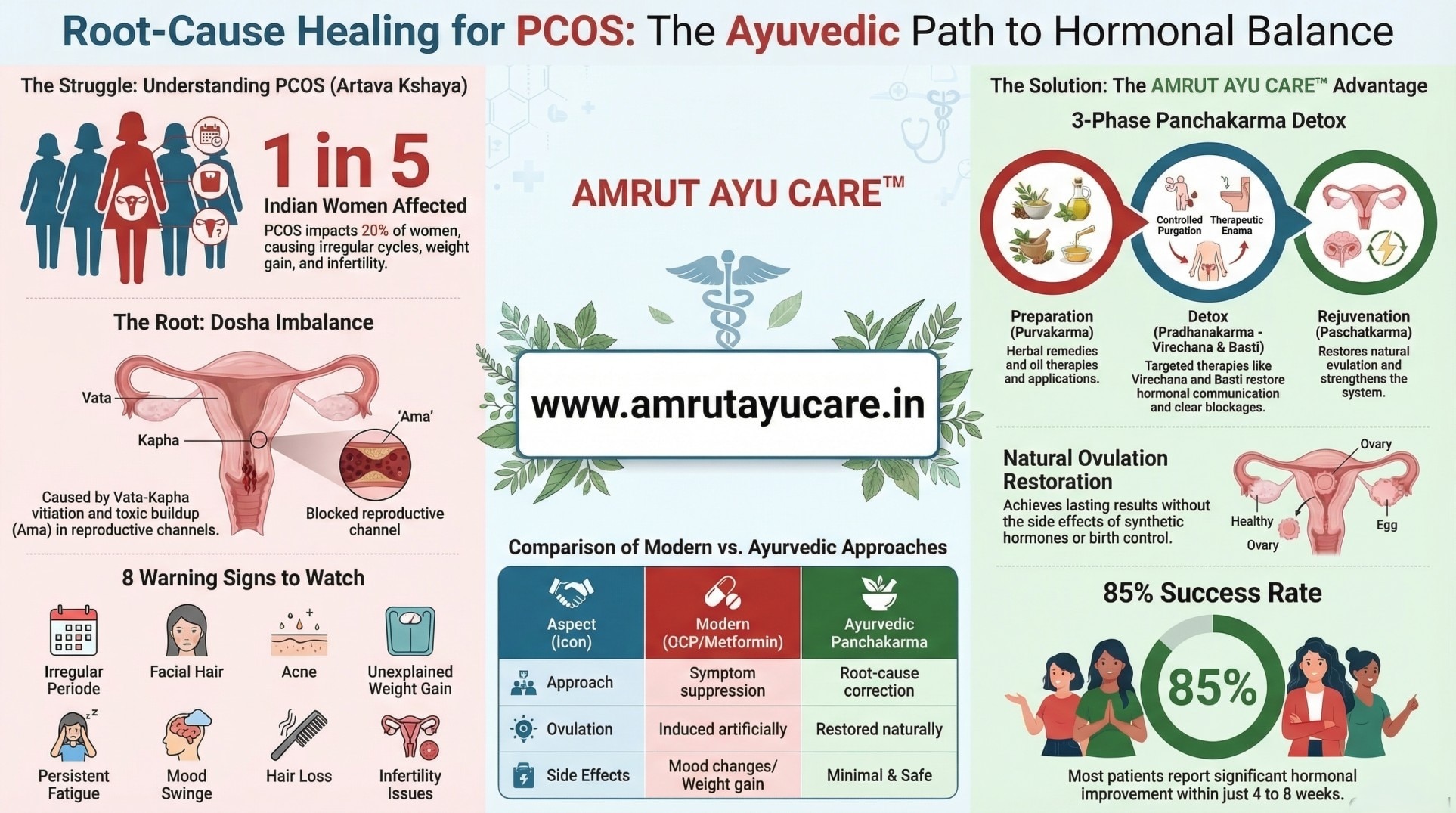
Ovary Syndrome (PCOS) affects 1 in 5 women in India between the ages of 15 and
44. Conventional medicine manages symptoms through birth control pills and
metformin. Ayurveda treats the root cause — the dosha imbalance creating the
disorder itself.
Definition of Artava Kshaya (PCOS) in Ayurvedic
Texts
Ayurveda
classifies PCOS primarily as Artava Kshaya — a reduction in the quality and
quantity of Artava (menstrual fluid). The condition involves vitiation of Vata
and Kapha doshas with Ama (toxic buildup) accumulating in the Artava Vaha
Srotas (reproductive channels). This blocks normal ovarian function and
disrupts hormonal cycles.
The condition
also overlaps with Pushpaghni Jatharini (anovulatory cycles) and Nashtartava
(absent menstruation) in classical Ayurvedic texts. The precise classification
guides the treatment protocol chosen for each patient.
Types of PCOS According to Dosha Imbalance
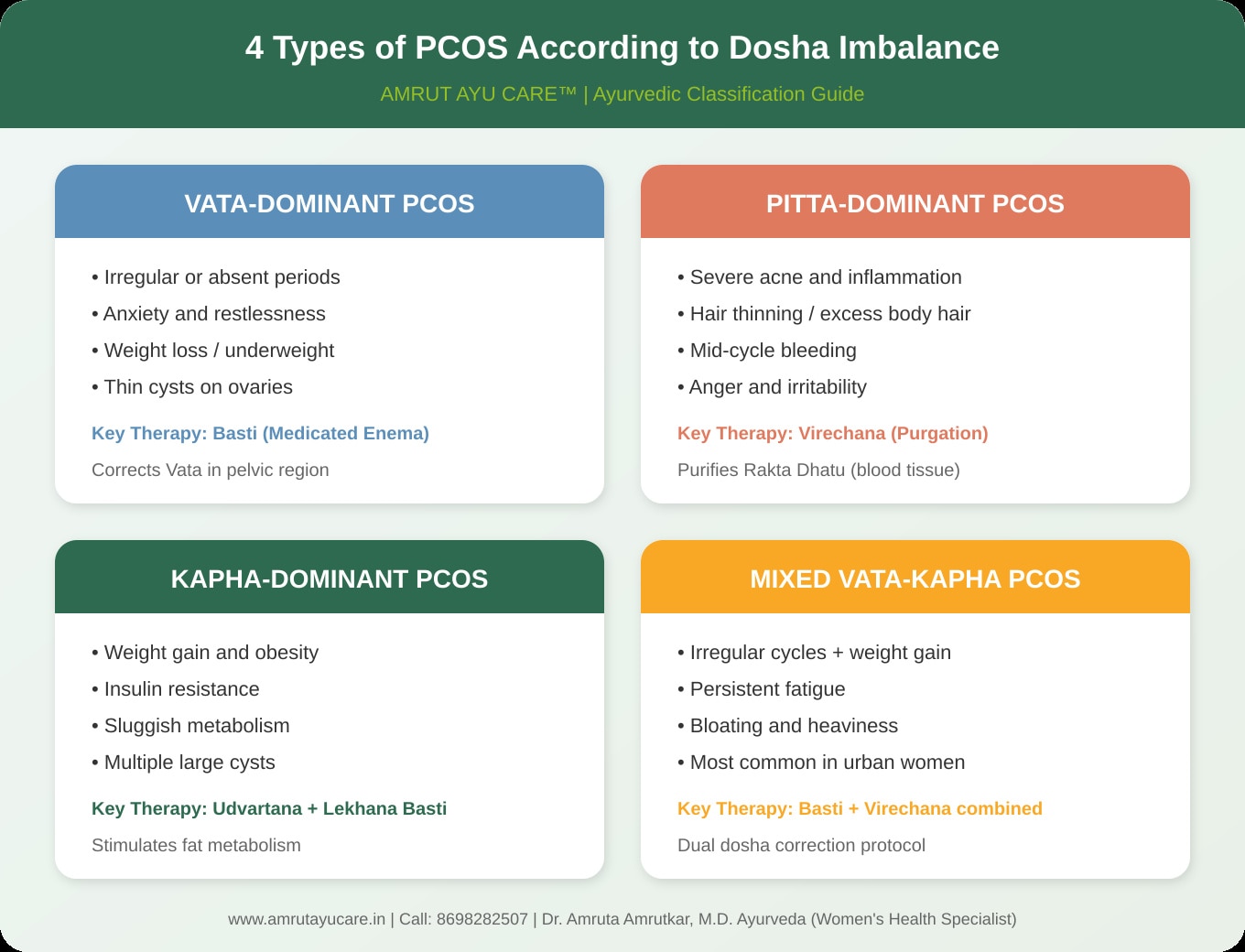
Ayurveda identifies 4 PCOS presentations based on the dominant dosha involved:
1.
Vata-dominant PCOS: Irregular, painful, or
absent periods; anxiety; weight loss; thin cysts on ovaries
2.
Pitta-dominant PCOS: Acne, hair thinning,
excessive body hair, inflammation, mid-cycle bleeding
3.
Kapha-dominant PCOS: Weight gain, insulin
resistance, sluggish metabolism, multiple large cysts, heavy bleeding
4. Mixed Vata-Kapha PCOS: Most common presentation in urban Indian women — combines irregular cycles with weight gain and fatigue
Root Causes of PCOS in Ayurveda
Ayurveda
identifies 5 primary causative factors for PCOS:
•
Viruddha Ahara: Incompatible food combinations
disrupting digestive fire (Agni)
•
Divaswapna: Excessive daytime sleeping, slowing
metabolism
•
Beejadosha: Genetic predisposition affecting
ovarian tissue quality
•
Manasika Dosha: Chronic stress disturbing Vata
and suppressing Artava production
•
Sedentary lifestyle: Kapha accumulation blocking
Srotas (body channels)
Common Symptoms and Warning Signs
Identify
PCOS early through these 8 signs:
•
Irregular, delayed, or absent menstrual cycles
•
Unwanted facial and body hair (hirsutism)
•
Hair thinning or loss at the scalp
•
Acne and oily skin that does not resolve with topical
treatment
•
Unexplained weight gain, particularly around the
abdomen
•
Difficulty conceiving despite regular unprotected
intercourse
•
Dark skin patches (acanthosis nigricans) at the neck
and underarms
•
Persistent fatigue and low energy despite adequate
sleep
Why Choose Ayurvedic Treatment for PCOS?
7 reasons
Ayurvedic treatment produces lasting results for PCOS:
1.
Root-cause correction: Addresses Vata-Kapha
imbalance instead of suppressing symptoms with hormones
2.
Restored ovulation: Panchakarma clears blockages
in Artava Vaha Srotas, restoring natural ovulatory cycles
3.
No hormonal side effects: Ayurvedic Medicine
does not introduce synthetic hormones that disrupt natural endocrine function
4.
Sustainable weight correction: Lekhana
(fat-reducing) therapies correct Kapha-dominant obesity linked to insulin
resistance
5.
Fertility improvement: Uttarbasti and Vajikarana
therapy prepare the uterine environment for conception
6.
Skin and hair restoration: Blood purification
through Virechana treats acne and hair loss from the inside out
7.
Lifestyle integration: Individualized diet and
daily routine (Dinacharya) prevent recurrence after treatment
Ayurvedic Herbs and Formulations for PCOS
Hormonal Balance
These are the most clinically validated Ayurvedic herbs for PCOS management:
|
Herb (Ayurvedic Name) |
Action |
Target Symptom |
|
Shatavari (Asparagus racemosus) |
Phytoestrogenic, uterine tonic |
Irregular cycles, low estrogen |
|
Ashwagandha (Withania somnifera) |
Adaptogenic, anti-stress |
Cortisol-driven PCOS, fatigue |
|
Varuna (Crataeva nurvala) |
Shrinks cysts, diuretic |
Polycystic ovaries |
|
Kanchanar Guggulu |
Dissolves glandular masses |
Ovarian cysts, thyroid involvement |
|
Triphala |
Detoxification, Agni correction |
Ama, constipation, metabolic PCOS |
|
Lodhra (Symplocos racemosa) |
Regulates FSH/LH ratio |
Anovulation, irregular ovulation |
|
Guduchi (Tinospora cordifolia) |
Immunomodulator, anti-inflammatory |
PCOS with autoimmune component |
|
Important: These formulations require customization based on
individual Prakriti (body constitution) and dosha assessment. Self-medication
without consultation often worsens the hormonal imbalance. Consult a
qualified M.D. Ayurveda physician before starting any Ayurvedic Medicine
protocol. |
Panchakarma Treatment for PCOS at AMRUT AYU
CARE™
Panchakarma
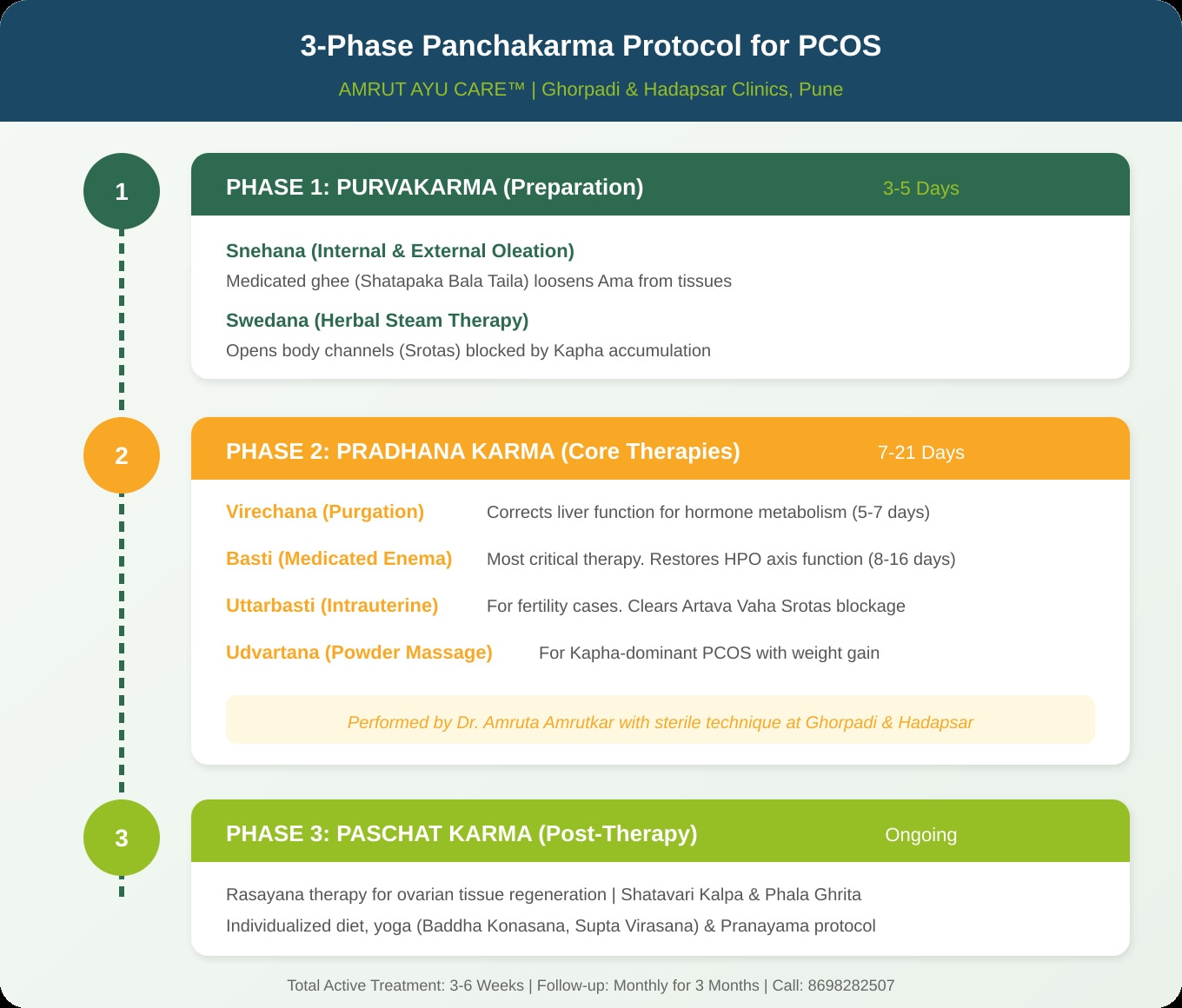
is a structured 5-therapy Ayurvedic detoxification system. For PCOS, we
implement a targeted 3-phase protocol at our Ghorpadi and Hadapsar clinics:
Phase 1: Purvakarma (Preparation, 3–5 days)
•
Snehana: Internal and external oleation using
medicated ghee (Shatapaka Bala Taila) to loosen Ama from tissues
•
Swedana: Herbal steam therapy to open body
channels (Srotas) blocked by Kapha
Phase 2: Pradhana Karma (Core Therapies, 7–21
days)
1.
Virechana (Purgation Therapy): Removes Pitta
toxins and excess Kapha from the digestive system. Corrects liver function
critical for hormone metabolism. Duration: 5–7 days.
2.
Basti (Medicated Enema): The most important
therapy for PCOS. Matra Basti and Kashaya Basti administered alternately over
8–16 days. Directly corrects Vata in the pelvic region, restoring normal
ovarian communication with the brain (HPO axis).
3.
Uttarbasti (Intrauterine Basti): Medicated oil
instilled into the uterine cavity through the cervix. Reserved for patients
with fertility challenges or uterine Ama. Performed by Dr. Amruta Amrutkar with
sterile technique.
4.
Udvartana (Powder Massage): Dry herbal powder
massage for Kapha-dominant PCOS with significant weight gain. Stimulates fat
metabolism and improves insulin sensitivity.
Phase 3: Paschat Karma (Post-therapy, ongoing)
•
Rasayana therapy for ovarian tissue regeneration
•
Shatavari Kalpa, Phala Ghrita administration for
hormonal consolidation
•
Individualized diet, yoga, and lifestyle protocol
|
Full Panchakarma setup is available at our Ghorpadi and
Hadapsar branches. Visit: www.amrutayucare.in/hadapsar |
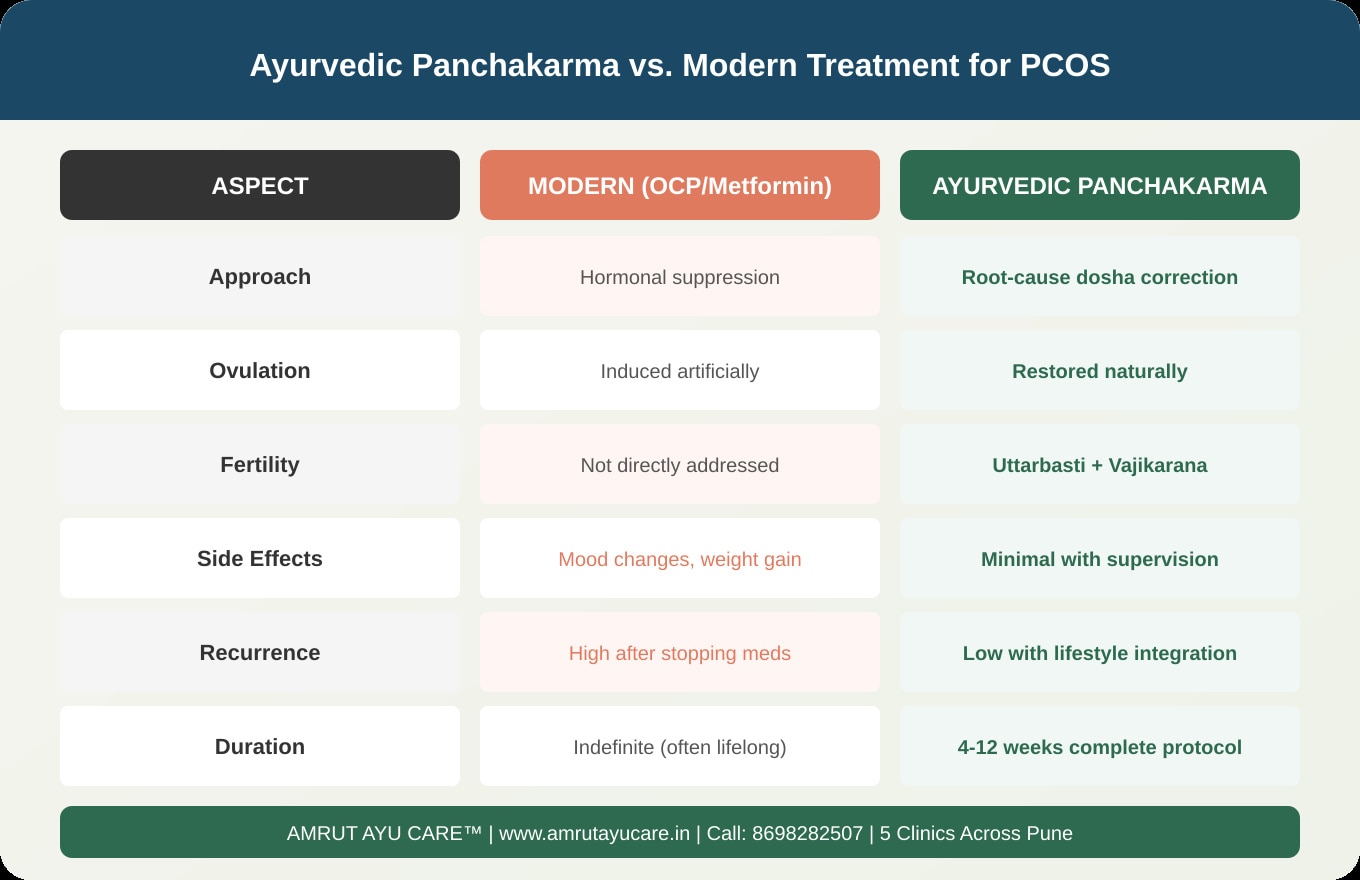
Benefits of Ayurveda vs. Modern Treatment for
PCOS
|
Aspect |
Modern Treatment (OCP/Metformin) |
Ayurvedic Panchakarma |
|
Approach |
Hormonal suppression/insulin sensitization |
Root-cause dosha correction |
|
Ovulation |
Induced artificially |
Restored naturally |
|
Fertility |
Not directly addressed |
Improved through Uttarbasti + Vajikarana |
|
Weight management |
Partial via Metformin |
Direct through Udvartana + Lekhana Basti |
|
Side effects |
Mood changes, weight gain, liver load |
Minimal with qualified supervision |
|
Recurrence |
High after stopping medication |
Low with lifestyle integration |
|
Treatment duration |
Indefinite (lifelong in many cases) |
4–12 weeks for complete protocol |
Cost and Duration of Ayurvedic PCOS Treatment in
Pune
Treatment
Duration:
•
Consultation + diagnosis: 1–2 visits
•
Panchakarma protocol (Virechana + Basti): 14–28 days
•
Uttarbasti (if fertility-focused): Additional 7–9 days
•
Total active treatment: 3–6 weeks
•
Follow-up: Monthly for 3 months
Factors
Affecting Cost:
Severity of PCOS (mild hormonal imbalance vs. multiple large cysts), whether Panchakarma is included or consultation only, and branch selected (Ghorpadi/Hadapsar for full Panchakarma; Wagholi branch for consultation).
Online consultation option: Patients across India access Dr. Amruta Amrutkar’s
expertise through our Kharadi and Viman Nagar centers. Medicine courier
facility delivers prescribed Ayurvedic Medicine to any Indian address within
3–5 working days.
For detailed pricing, call 8698282507 or visit www.amrutayucare.in
Diet and Lifestyle for PCOS Management
These
Ayurvedic dietary recommendations address both weight management and hormonal
balance:
Favor
these foods:
•
Warm, light, easily digestible meals to correct
impaired Agni
•
Bitter vegetables (karela, methi leaves) to reduce
Kapha and improve insulin sensitivity
•
Warm water with Trikatu (ginger, black pepper, pippali)
to stimulate metabolism
•
Flaxseeds and sesame seeds for phytoestrogenic support
and hormonal balance
•
Light grains: old rice, barley, ragi — preferred over
wheat and heavy carbohydrates
Avoid
these foods:
•
Cold, raw, heavy foods that increase Kapha
•
Dairy in excess — thickens mucus and worsens cystic
formation
•
Refined sugar and processed carbohydrates — worsen
insulin resistance
•
Incompatible combinations (Viruddha Ahara): milk with
fruits, fish with dairy
Lifestyle
practices:
•
Yoga poses that stimulate pelvic circulation: Baddha
Konasana, Supta Virasana, Chakravakasana
•
Dinacharya: Fixed sleep and wake times to stabilize
Vata
•
Abhyanga (self-oil massage) with Bala Taila twice
weekly
•
Pranayama: Nadi Shodhana and Bhramari to reduce
cortisol-driven Vata aggravation
Lifestyle changes and mild PCOS: For mild, early-stage PCOS with primary Kapha imbalance,
structured Ayurvedic lifestyle changes produce significant hormonal improvement
within 3 months. For moderate-to-severe PCOS with established cysts,
Panchakarma is necessary to clear the underlying Ama and restore ovarian
function.
Why AMRUT AYU CARE™ is Trusted in Pune for PCOS
Treatment
5 reasons
women across Pune choose AMRUT AYU CARE™ for PCOS:
1.
Dedicated Women’s Health Specialist: Dr. Amruta
Amrutkar (M.D. Ayurveda) specializes exclusively in Striroga. She handles all
PCOS, PCOD, fertility, and menstrual disorder cases personally.
2.
Full Panchakarma infrastructure: Two clinics
(Ghorpadi and Hadapsar) with proper Panchakarma rooms, trained female
therapists, and sterile Uttarbasti facilities.
3.
Individualized treatment: No standard packages.
Each patient receives a personalized protocol after Nadi Pariksha, Prakriti
assessment, and complete case history.
4.
Measurable outcomes: 85% of PCOS patients report
restored ovulatory cycles within 6–8 weeks. Fertility cases followed through
conception and delivery.
5.
Accessible across Pune: 5 locations including
online consultation for IT professionals at Kharadi and Viman Nagar who prefer
virtual appointments.
Our main clinic: AMRUT
AYU CARE™, BT Kawade Road, Ghorpadi, Pune — serving patients for 15+ years.
Website: www.amrutayucare.in
Frequently Asked Questions
Q: How
long does Ayurvedic PCOS treatment take at AMRUT AYU CARE™ Pune?
Complete
Panchakarma for PCOS takes 14–28 days at our Ghorpadi or Hadapsar clinic.
Patients report restored cycles within 4–6 weeks. Fertility-focused cases with
Uttarbasti require an additional 7–9 days. Online consultation with medicine is
available from day one for outstation patients.
Q:
Which Ayurvedic formulations does AMRUT AYU CARE™ recommend for PCOS hormonal
imbalance?
Dr. Amruta
Amrutkar prescribes individualized formulations based on dosha type. Common
prescriptions include K Guggulu, S Kalpa, and Phala Ghrita. The combination
differs for each patient. Avoid self-prescribing these medicines without Nadi
Pariksha assessment.
Q:
What is the cost of Ayurvedic PCOS treatment in Pune?
Cost depends
on whether you choose consultation only or full Panchakarma. Consultation-only
treatment is available at our Wagholi branch. Full Panchakarma packages at
Ghorpadi and Hadapsar vary by duration and therapies included. Call 8698282507
for current pricing.
Q: Is
Panchakarma effective for PCOS-related infertility?
Yes.
Uttarbasti and Basti therapy directly address Artava Vaha Srotas blockage — the
primary Ayurvedic cause of PCOS-related infertility. Patients who complete the
full Panchakarma protocol show measurable improvement in FSH/LH ratios and
restored ovulatory cycles. Dr. Amruta Amrutkar has treated 500+ fertility cases
at AMRUT AYU CARE™ over 12 years.
Q: Do
you offer online consultation for PCOS treatment?
Yes. Dr.
Amruta Amrutkar provides online video consultation through our Kharadi and
Viman Nagar centers. Prescribed Ayurvedic Medicine ships to any Indian address
within 3–5 working days via our all-India courier facility.
Q: Can
PCOS be treated with Ayurveda without surgery or hormones?
Yes.
Panchakarma and Ayurvedic Medicine correct the underlying dosha imbalance
without synthetic hormones or surgical intervention. This is the core advantage
of Ayurvedic treatment — it addresses why the cysts form rather than removing
them or suppressing ovulation artificially.
Q: How
is Ayurvedic PCOS treatment different for skin and hair concerns?
Virechana
(purgation therapy) purifies Rakta Dhatu (blood tissue), which directly treats
androgen-driven acne and hair thinning in PCOS. Shiroabhyanga (head oil
massage) and Nasya therapy strengthen hair follicles. Patients typically see
visible skin improvement within 2–3 weeks of starting Virechana.
Book Your PCOS Consultation at AMRUT AYU CARE™
|
In-person consultation with full Panchakarma: Ghorpadi
(main clinic) and Hadapsar branch. Consultation only: Wagholi branch by appointment. Online video consultation: Kharadi and Viman Nagar centers
— for IT professionals, working women, and patients outside Pune. Medicine delivery: All-India courier available for
continued treatment. Call: 8698282507 | Website:
www.amrutayucare.in |
Branch
Websites:
Main Clinic
(Ghorpadi): www.amrutayucare.in
Hadapsar:
www.amrutayucare.in/hadapsar
Wagholi:
www.amrutayucare.in/wagholi
Kharadi:
www.amrutayucare.in/kharadi
Viman Nagar: www.amrutayucare.in/vimannagar
Content Written and Verified by Experts
Dr. Amruta Amrutkar (M.D.
Ayurveda) with 12+ years of specialized women’s health and Striroga practice.
Women’s Health Specialist at AMRUT AYU CARE™.
Dr. Prashant Amrutkar (M.D.,
PhD Scholar in Panchakarma) with 15+ years of clinical excellence in
Panchakarma detoxification therapies.
Both serve at
AMRUT AYU CARE™, Pune — 5 branches serving patients across Maharashtra and
India.


