
Panchakarma for Arthritis & Joint Pain in Pune By AMRUT AYU CARE™
Arthritis (Sandhivata) affects joints due to Vata imbalance. Get Basti and Janu Basti treatment at AMRUT AYU CARE™ Pune. 40-60% RF factor improvement. Book now.
Key Takeaways
•
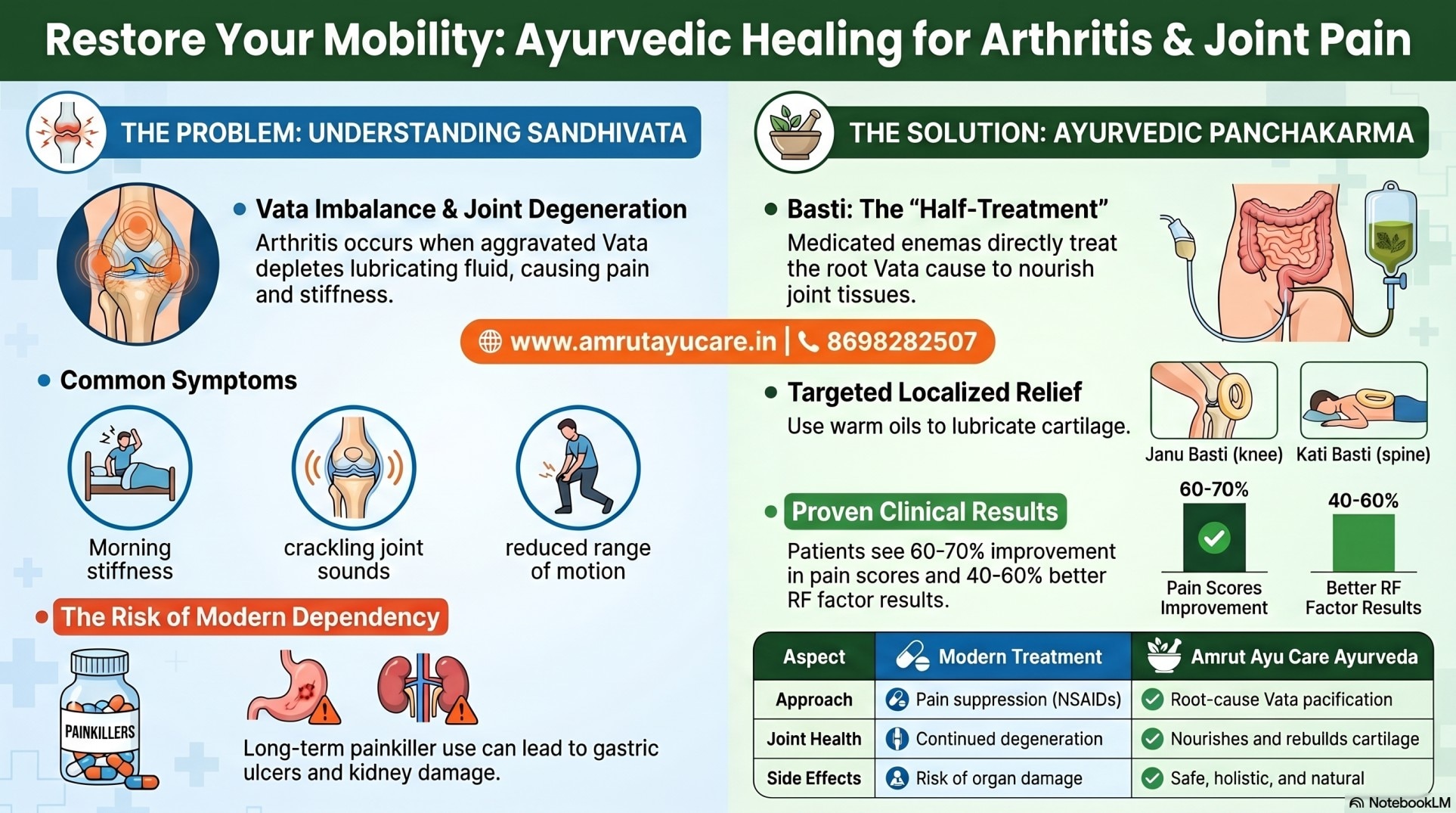
60-70%
improvement in pain scores with Panchakarma.
•
Basti therapy
directly treats Vata, the root cause of joint disorders.
•
Janu Basti (knee)
and Kati Basti (lower back) for targeted relief.
•
No painkillers,
no steroids, no dependency.
•
Full Panchakarma
setup at Ghorpadi and Hadapsar clinics in Pune.
What is Arthritis in Ayurveda?
Definition of
Sandhivata in Ayurvedic Texts
Arthritis is called Sandhivata in Ayurveda.
“Sandhi” means joint and “Vata” refers to the dosha causing the disease. When
aggravated Vata lodges in the joints, it depletes the lubricating fluid
(Shleshaka Kapha) and causes pain, stiffness, and degeneration.
Charaka Samhita describes Sandhivata as part of
Vatavyadhi (diseases caused by Vata). The condition manifests when Vata enters
empty spaces in the joints, causing crackling sounds (Sandhisphutana), swelling
(Shotha), and pain during movement (Vedana).
Types of
Arthritis According to Ayurveda
1. Sandhivata (Osteoarthritis)
Degenerative joint disease caused by pure Vata
aggravation. It affects weight-bearing joints like knees, hips, and spine and
is the focus of our Ayurvedic osteoarthritis care. Common in the elderly and those with a sedentary
lifestyle.
2. Amavata (Rheumatoid Arthritis)
Inflammatory arthritis caused by Ama (toxins) combined
with Vata. This is the focus of our rheumatoid arthritis (Amavata) treatment — it affects multiple joints symmetrically, with
morning stiffness, joint swelling, and systemic symptoms.
3. Vatarakta (Gouty Arthritis)
When vitiated Vata combines with vitiated Rakta
(blood). Causes acute painful attacks, often starting in the big toe, and is
associated with high uric acid levels — see our gouty arthritis and uric acid management.
4. Gridhrasi (Sciatica)
Vata affecting the sciatic nerve. It causes radiating
pain from the lower back to the leg and responds well to sciatica nerve pain relief. Often accompanies lumbar spondylosis.
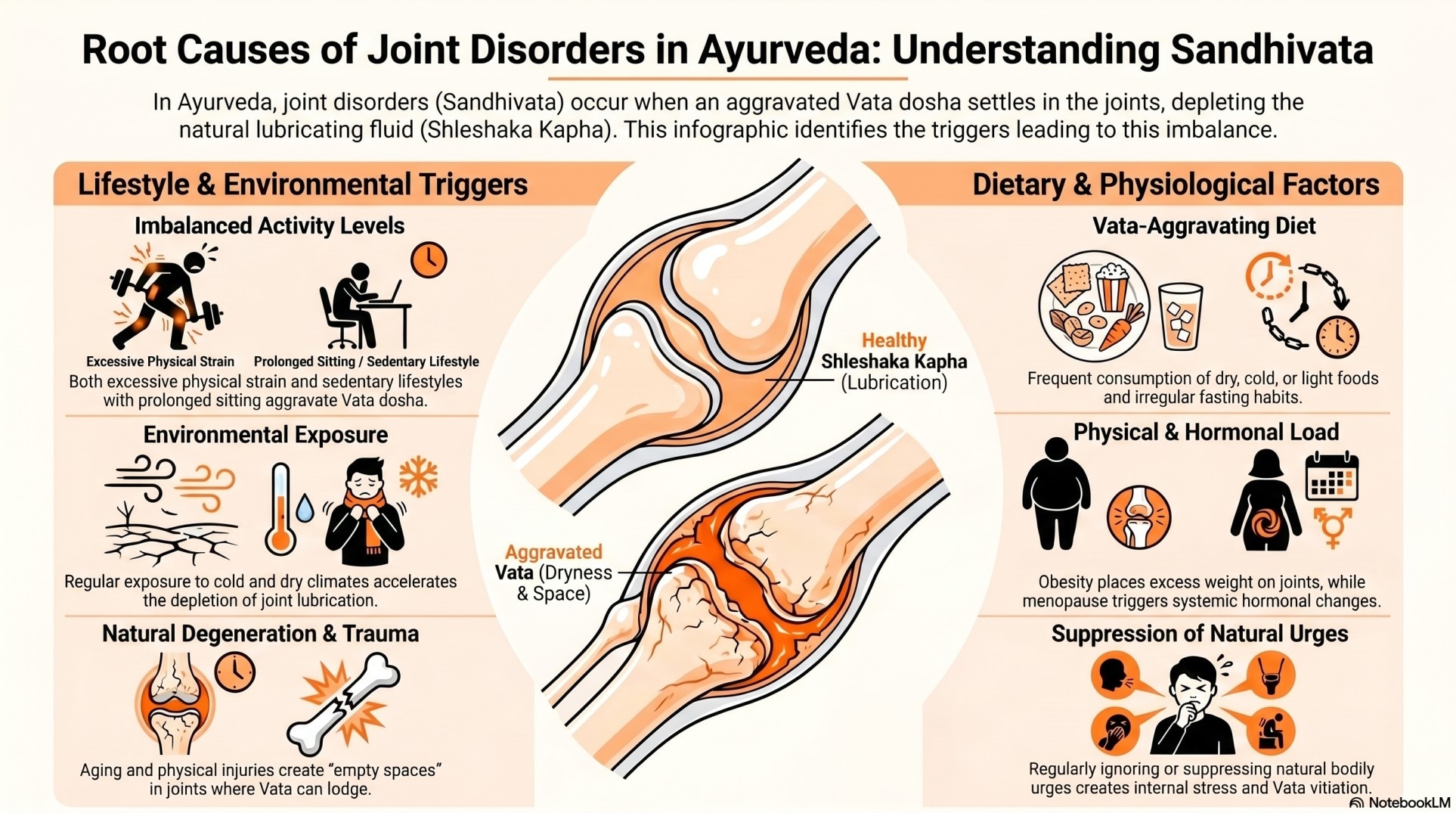
Root Causes of
Joint Disorders in Ayurveda
•
Aging and natural
degeneration
•
Excessive
physical strain on joints
•
Sedentary
lifestyle with prolonged sitting
•
Vata-aggravating
diet (dry, cold, light foods)
•
Irregular eating
habits and fasting
•
Suppression of
natural urges
•
Trauma and
injuries
•
Obesity placing
excess load on joints
•
Cold and dry
climate exposure
•
Hormonal changes
(menopause in women)
Common Symptoms
of Arthritis
•
Joint pain that
worsens with activity or rest (depending on type)
•
Morning stiffness
lasting 30 minutes to several hours
•
Crackling or
grinding sounds in joints
•
Swelling and
tenderness around joints
•
Reduced range of
motion
•
Joint deformity
in advanced stages
•
Weakness and
muscle wasting around affected joints
•
Fatigue and
general weakness
•
Positive RF
factor (in Rheumatoid Arthritis)
•
Elevated ESR and
CRP levels
Why Choose Ayurvedic Treatment for Arthritis?
1. Root-Cause Approach: Ayurveda treats the underlying Vata imbalance, not
just pain symptoms. This prevents progressive degeneration and provides lasting
relief.
2. No Painkiller Dependency: Modern NSAIDs cause gastric ulcers, kidney damage, and
cardiovascular risks with long-term use. Ayurvedic Medicine is safe for years.
3. Cartilage Nourishment: Therapies like Basti and Janu Basti nourish joint
cartilage. Medicated oils penetrate deep tissues and rebuild joint structures.
4. Inflammatory Marker Reduction: 40-60% of patients show measurable improvement in RF
factor, ESR, and CRP levels after Panchakarma treatment.
5. Mobility Restoration: Combined with physiotherapy and yoga, patients regain
functional mobility. Many avoid or delay joint replacement surgery.
6. Holistic Healing: Treatment includes diet modification, lifestyle changes, and stress
management, addressing all factors contributing to joint health.
7. Suitable for All Ages: From young patients with early arthritis to elderly
with severe degeneration, treatment protocols adapt to individual needs.
Panchakarma Treatment for Arthritis at AMRUT AYU CARE™
Primary Therapy:
Basti (Medicated Enema)
Basti is the cornerstone of arthritis treatment and
the centrepiece of our broader Panchakarma detox therapy.
Charaka states “Basti is half of the entire
treatment” because of its
unparalleled efficacy in Vata disorders.
Kala Basti Protocol (16 Days)
|
Day |
Basti Type |
Purpose |
|
1 |
Anuvasana (Oil) |
Nourishes joint tissues |
|
2-5 |
Alternating Niruha & Anuvasana |
Cleanses and nourishes |
|
6-11 |
Alternating Niruha & Anuvasana |
Deep tissue treatment |
|
12-16 |
Anuvasana sequence |
Consolidates benefits |
Specific Basti Formulations
•
Dashamoola
Kashaya for inflammation
•
Erandamoola
Kashaya for Vata pacification
•
Ksheerabala Taila
for nourishment
•
Dhanwantaram
Taila for degeneration
Localized
Therapies
- Janu Basti (For Knee Arthritis)
Warm medicated oil retained over the knee using a
dough dam for 30–45 minutes. This Janu
Basti for knee pain penetrates the
knee joint, lubricates cartilage, and reduces pain. Course: 7–14 days.
- Kati Basti (For Lower Back and Spine)
Oil pooling over the lumbar region. Kati
Basti for the lower back treats
lumbar spondylosis, disc problems, and sacroiliac joint disorders. Essential
for spine-related arthritis.
- Greeva Basti (For Cervical Spondylosis)
Oil retention over the neck region. It addresses cervical spondylosis treatment, frozen shoulder, and upper back stiffness.
- Pinda Sweda (Bolus Massage)
Hot boluses made with rice cooked in milk and herbs
(Shashtika Shali Pinda Sweda). Pinda
Sweda bolus massage deeply nourishes
muscles and joints. Excellent for muscle wasting around arthritic joints.
Preparatory
Therapies
- Abhyanga (Oil Massage)
Full body massage with warm medicated oils like
Dhanwantaram Taila, Ksheerabala Taila, or Sahacharadi Taila. Performed daily
for 45-60 minutes.
- Swedana (Steam Therapy)
Herbal steam bath following oil massage. Opens
channels, improves circulation, and prepares joints for main treatment.
- Internal
Medicines
Customized oral medicines are given based on arthritis
type.
Treatment Protocol Based on Arthritis Type
Osteoarthritis
(Sandhivata) - 14-21 Days
|
Week |
Focus |
Therapies |
|
Week 1 |
Preparation |
Abhyanga, Swedana, Deepana |
|
Week 2 |
Main Treatment |
Kala Basti + Janu/Kati Basti |
|
Week 3 |
Consolidation |
Pinda Sweda, Internal medicines |
Expected Outcomes:
•
40-60% pain
reduction
•
Improved joint
mobility
•
Reduced crackling
sounds
•
Decreased
dependency on painkillers
Rheumatoid
Arthritis (Amavata) - 21-30 Days
|
Phase |
Focus |
Therapies |
|
Phase 1 (7 days) |
Ama Pachana |
Digestive medicines, Light diet |
|
Phase 2 (7 days) |
Shodhana |
Virechana, Basti |
|
Phase 3 (7-14 days) |
Shamana |
External therapies, Medicines |
Expected Outcomes:
•
40-60%
improvement in RF factor
•
Reduced morning
stiffness
•
Decreased joint
swelling
•
Lower ESR and CRP
levels
Gouty Arthritis
(Vatarakta) - 14-21 Days
|
Phase |
Focus |
Therapies |
|
Phase 1 |
Blood Purification |
Virechana, Raktamokshana |
|
Phase 2 |
Vata Pacification |
Basti, Local therapies |
|
Phase 3 |
Uric Acid Control |
Medicines, Diet management |
Expected Outcomes:
•
Reduced uric acid
levels
•
Decreased
frequency of acute attacks
•
Less joint pain
and swelling
Benefits of Ayurveda vs. Modern Treatment for Arthritis
|
Aspect |
Modern Treatment |
Ayurvedic Panchakarma |
|
Approach |
Pain suppression with NSAIDs/steroids |
Root-cause treatment through Vata
pacification |
|
Joint Health |
Cartilage degeneration continues |
Nourishes and protects cartilage |
|
Side Effects |
Gastric ulcers, kidney/liver damage |
No systemic side effects |
|
Dependency |
Long-term medication required |
Reduced medicine dependency over time |
|
RA Markers |
Immunosuppressants with infection risk |
40-60% improvement in RF without immune
suppression |
|
Surgery Need |
Often recommended for advanced cases |
Many patients avoid or delay surgery |
|
Cost (Long-term) |
Ongoing medication + surgery costs |
One-time treatment with maintenance |
Why AMRUT AYU CARE™ is Trusted in Pune for Arthritis Treatment
Specialized Joint
Care Program
Our structured 14-30 day protocols combine multiple
therapies for comprehensive joint treatment. Every therapy is scheduled for
optimal synergy.
Fresh Basti
Preparations
Basti medicines are prepared fresh daily using
classical formulas. Decoctions are made from whole herbs, not extracts,
ensuring full potency.
Localized Therapy
Expertise
Our therapists have 8+ years of experience in Janu
Basti and Kati Basti. Proper technique ensures oil penetration into joint
structures.
Integrated
Physiotherapy
Post-Panchakarma physiotherapy and yoga sessions
strengthen muscles around joints. Prevents recurrence and improves long-term
outcomes.
Diet and
Lifestyle Counselling
Personalized anti-inflammatory diet plan. Specific
instructions on activities to avoid and joint-protective habits.
Follow-up Care
Monthly follow-up consultations for 6 months.
Home-based Matra Basti training for maintenance. Medicine adjustments based on
progress.
Arthritis Treatment Cost in Pune
|
Package Type |
Duration |
Estimated Cost |
|
Basic Joint Care |
7-10 Days |
₹5,000 - ₹15,000 |
|
Standard Arthritis Package |
14-21 Days |
₹15,000 - ₹30,000 |
|
Comprehensive RA Treatment |
21-30 Days |
₹40,000 - ₹60,000 |
|
Premium Residential Package |
14-21 Days |
₹60,000 - ₹1,00,000 |
Prices include consultation, Panchakarma
therapies, localized treatments, internal medicines, diet counselling, and
follow-up. Actual cost varies based on condition severity and treatment
requirements.
Frequently Asked Questions
Q: How
long does Ayurvedic treatment for arthritis take?
A: Initial relief is felt within 7-10 days. Complete
treatment takes 14-30 days depending on severity. Chronic cases may need 2-3
treatment courses over a year for maximum benefit.
Q: Is
Panchakarma treatment painful for arthritic patients?
A: No. Therapies like Abhyanga, Janu Basti, and Pinda
Sweda are soothing and relaxing. Patients often report the treatment as the
most comfortable part of their arthritis journey.
Q: Can I
stop my current arthritis medications during treatment?
A: We recommend gradual tapering under medical
supervision. Many patients reduce medication dosage by 50-70% after completing
Panchakarma. Complete stoppage depends on individual response.
Q: Will
my arthritis come back after treatment?
A: Results last 6-12 months or longer with proper
lifestyle maintenance. Annual Panchakarma sessions and daily Matra Basti at
home extend benefits indefinitely.
Q: Is
this treatment suitable for elderly patients?
A: Yes. We modify treatment intensity based on age and
stamina. Elderly patients often benefit most from Basti therapy as it is gentle
yet highly effective.
Q: Do you
treat rheumatoid arthritis (RA)?
A: Yes. We have specific protocols for RA (Amavata)
that combine Virechana, Basti, and specialized medicines. 40-60% of our RA
patients show improvement in RF factor.
Q: What
diet should I follow for arthritis?
A: Avoid cold, dry, and raw foods. Include warm,
cooked, and easily digestible meals. Specific anti-inflammatory foods like
ginger, turmeric, and garlic are beneficial. We provide detailed diet charts.
Book Your Arthritis Consultation
Get lasting relief from joint pain without painkillers
or surgery. Experience authentic Panchakarma treatment at AMRUT AYU CARE™. You
can also book an online consultation with our physicians from anywhere in India.
For Full
Panchakarma Treatment:
•
Main Clinic - Ghorpadi: BT Kawade Road, Ghorpadi, Pune
•
Hadapsar Branch:
Full Panchakarma Setup
For
Consultation:
•
Wagholi Branch:
Kesnand Road, Wagholi
For
Online Consultation:
•
Kharadi | Viman
Nagar
Medicine Courier Facility Available All Over India
Content Written and Verified by Experts
•
Dr. Prashant Amrutkar (M.D., PhD Scholar in Panchakarma) with 15+ years of
clinical excellence in Panchakarma
•
Dr. Amruta Amrutkar (M.D. Ayurveda) with 12+ years of specialized Ayurvedic practice
•
Both serve at
AMRUT AYU CARE™
AMRUT AYU CARE™ - Authentic Panchakarma Treatment in Pune Since 2009 | 5 Locations: Ghorpadi | Hadapsar | Wagholi | Kharadi | Viman Nagar


