
|
Ayurvedic Diet Chart for Obesity
(Sthaulya) Complete Weight Loss Diet Plan by
AMRUT AYU CARE™, Pune |
|
5 KEY TAKEAWAYS ✔ Diet Type:
Kapha-Meda pacifying, Agni-kindling Ayurvedic meal plan for obesity ✔ Structure: 3
main meals + 2 therapeutic drinks, timed to circadian Dosha rhythm ✔ Foundation:
Based on Charaka Samhita's Sthaulya Chikitsa (obesity treatment) principles ✔ Expert
Guidance: Designed by Dr. Prashant & Dr. Amruta Amrutkar (M.D. Ayurveda,
15+ years) ✔ Availability:
Personalized diet plans at 5 AMRUT AYU CARE™ clinics across Pune + online
consultation |
Ayurvedic Diet Chart for Obesity: A Complete
Guide
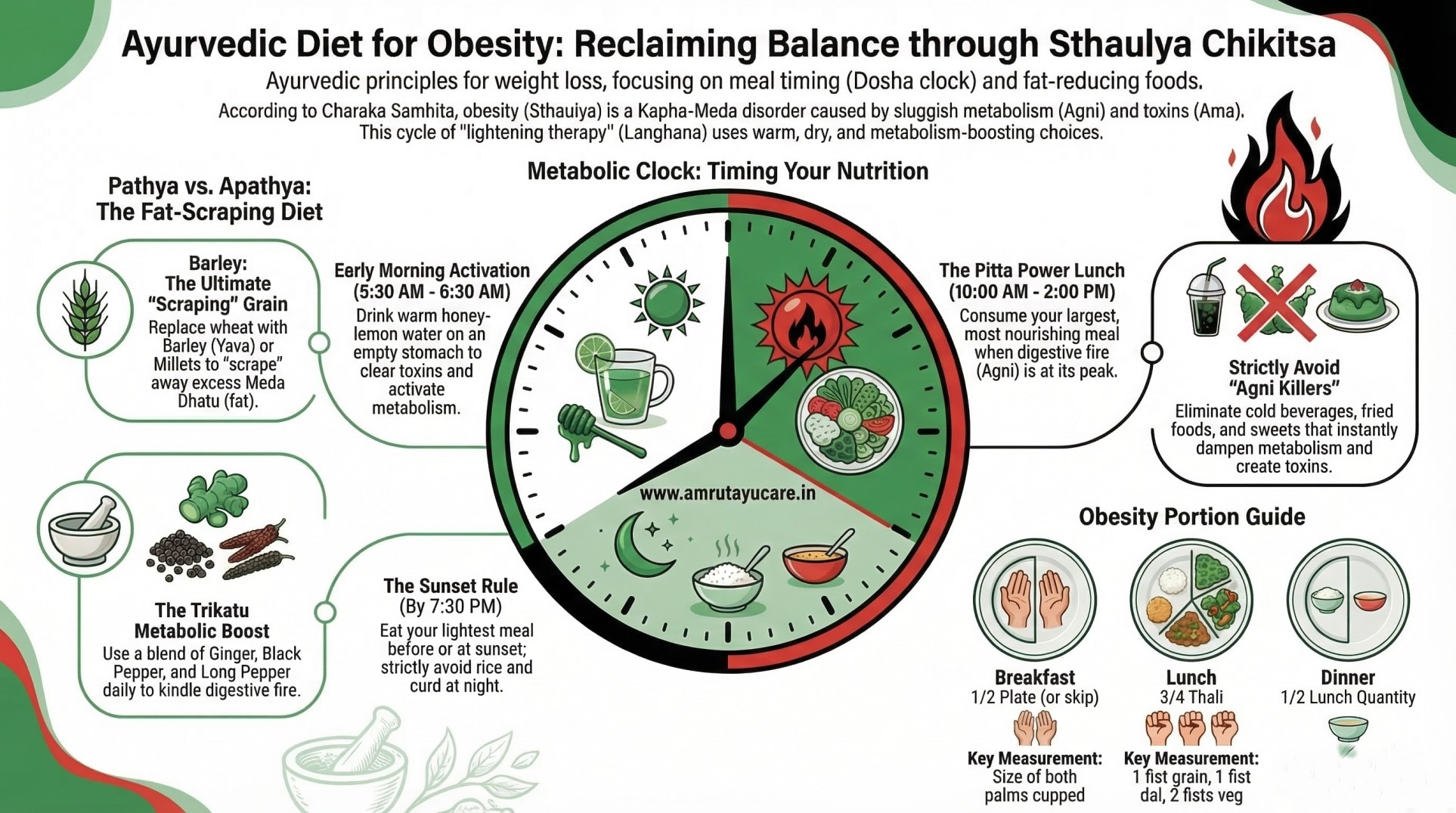
Obesity (Sthaulya) is a Kapha-Meda disorder
caused by impaired Agni (digestive fire) and excessive Ama (toxin)
accumulation. Charaka Samhita prescribes Langhana (lightening therapy) and
Ruksha Ahara (dry, light foods) as the first line of treatment.
This diet chart follows 6 core Ayurvedic
dietary principles for obesity management:
1.
Langhana Ahara: Light, easy-to-digest foods that
reduce body bulk
2.
Ruksha Guna: Dry-quality foods to counter
Kapha's oiliness and heaviness
3.
Ushna Virya: Warm-potency foods to boost
sluggish metabolism
4.
Katu-Tikta-Kashaya Rasa: Pungent, bitter, and
astringent tastes that reduce Kapha-Meda
5.
Agni Deepana: Spices and preparations that
kindle digestive fire
6.
Kala Bhojana: Time-specific eating aligned with
Dosha dominance cycles
At AMRUT AYU CARE™, our doctors customize this diet based on individual Prakriti (body constitution), Vikriti (current imbalance), and Agni status.
Understanding the Dosha Clock for Meal Timing
Ayurveda divides the day into
Dosha-dominant periods. Eating at the right time is as important as eating the
right food.
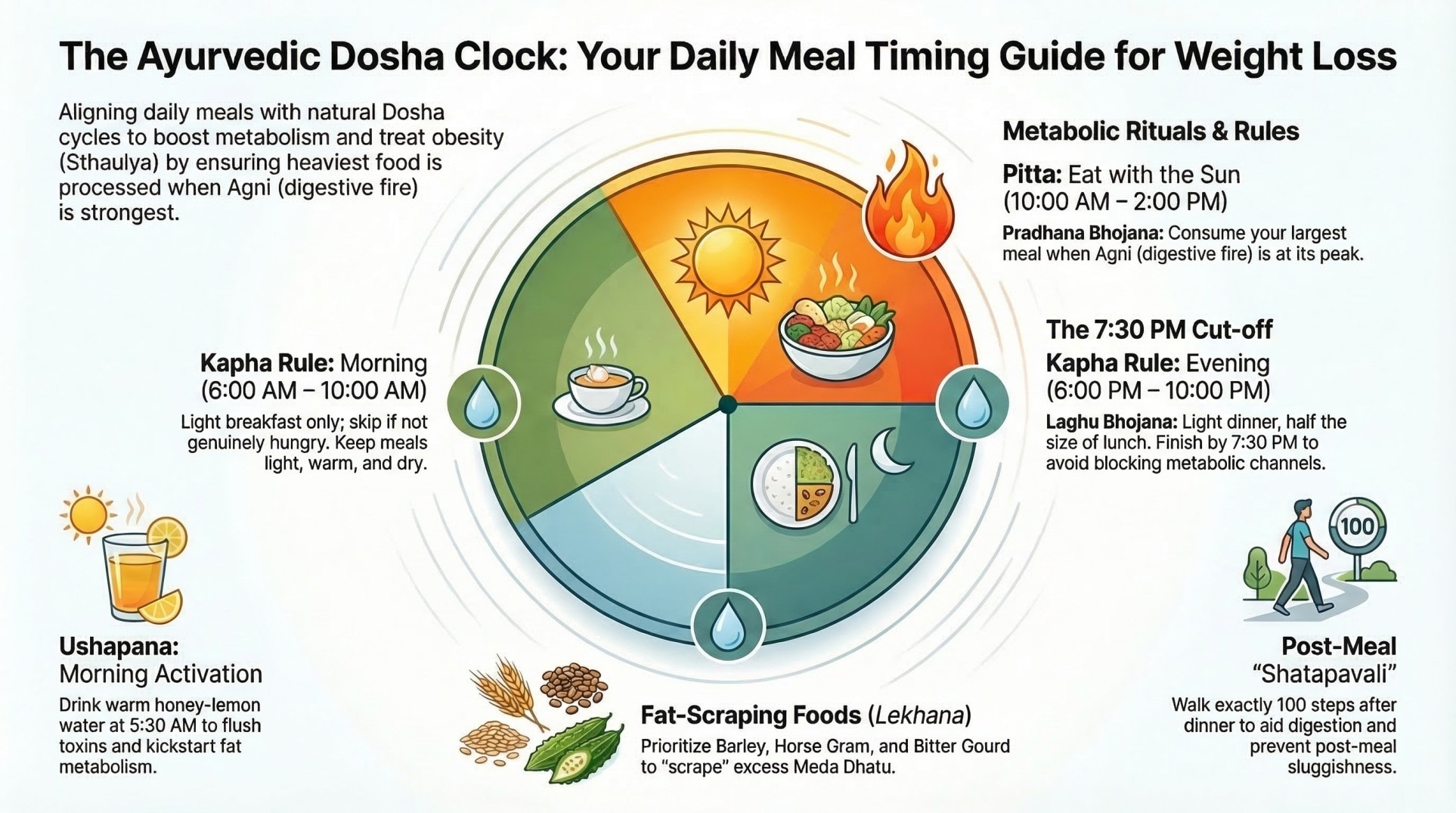
|
Time
Period |
Dominant
Dosha |
Dietary
Action |
|
6:00 AM - 10:00 AM |
Kapha |
Light breakfast. Avoid heavy, sweet, oily foods. |
|
10:00 AM - 2:00 PM |
Pitta |
Largest meal of the day. Agni is strongest. |
|
2:00 PM - 6:00 PM |
Vata |
Light snack if hungry. Avoid skipping meals. |
|
6:00 PM - 10:00 PM |
Kapha |
Early, light dinner. Finish eating by 7:30 PM. |
Daily Diet Schedule: Ayurvedic Meal Plan for
Obesity
Early Morning (5:30 AM - 6:30 AM): Ushapana
(Morning Drink)
Start the day with a therapeutic drink on
an empty stomach. This practice is called Ushapana in Ayurveda and is critical
for Ama removal and metabolism activation.
Choose ONE of the following:
|
Option |
Recipe |
Purpose |
|
Warm Honey-Lemon Water |
1 glass warm water + 1 tsp raw honey + half lemon |
Kapha-Meda reduction, Agni activation |
|
Triphala Water |
Soak 1 tsp Triphala Churna in warm water overnight, strain and
drink |
Toxin removal, bowel regulation |
|
Methi (Fenugreek) Water |
Soak 1 tsp methi seeds overnight, drink the water |
Blood sugar control, fat metabolism |
|
Warm Water with Trikatu |
1 glass warm water + pinch of Trikatu Churna |
Strong Agni stimulation (for Kapha types) |
•
Use lukewarm water, not cold or boiling hot
•
Honey must not be heated above 40°C (add to warm water,
not boiling)
•
Wait 30-45 minutes before eating breakfast
• Walk for 10-15 minutes after drinking
Breakfast (7:30 AM - 8:30 AM): Light and Warm
Breakfast during Kapha time must be light. Obesity patients
should avoid traditional heavy breakfasts (poha with excess oil, upma with
ghee, bread-butter).
Recommended Breakfast Options (Choose ONE daily):
|
Day |
Breakfast |
Qty |
Preparation
Notes |
|
Monday |
Moong Dal Cheela |
2 medium |
Made with minimal oil on iron tawa. Add ginger, cumin, turmeric
to batter. |
|
Tuesday |
Barley Porridge (Yava Daliya) |
1 bowl |
Cook barley flakes in water. Add rock salt, black pepper, cumin.
No sugar. |
|
Wednesday |
Ragi (Finger Millet) Dosa |
2 medium |
Fermented ragi batter on non-stick pan. Serve with green chutney. |
|
Thursday |
Kulith (Horse Gram) Soup |
1 bowl |
Boil horse gram, temper with cumin, garlic, curry leaves. Strain
or eat whole. |
|
Friday |
Vegetable Oats Upma |
1 bowl |
Dry-roasted oats cooked with vegetables, mustard seeds, turmeric.
No oil. |
|
Saturday |
Sprouted Moong Salad |
1 bowl |
Sprouted green gram + onion + tomato + lemon + black pepper +
rock salt. |
|
Sunday |
Jowar Roti + Green Chutney |
1 roti |
Fresh jowar roti with coriander-mint chutney. No butter or ghee. |
Breakfast Rules for Obesity Patients:
•
Eat only when you feel genuine hunger (not by clock)
•
No milk tea, coffee, or sugary beverages with breakfast
•
No white bread, refined flour products, or packaged
cereals
• If not hungry, skip breakfast and drink warm water instead (intermittent Langhana)
Mid-Morning (10:00 AM - 10:30 AM): Agni Deepana Drink
A metabolism-boosting drink between breakfast and lunch
supports fat burning during the Pitta transition period.
|
Drink |
Recipe |
Benefit |
|
Jeera (Cumin) Water |
Boil 1 tsp cumin in 2 cups water, reduce to 1 cup, strain |
Improves Agni, reduces bloating |
|
Coriander-Fennel Water |
Boil 1 tsp each of dhaniya + saunf in water, strain |
Mild Pitta balance, fat metabolism |
|
Green Tea with Ginger |
1 cup green tea + fresh ginger slice |
Antioxidant, Kapha reduction |
|
Takra (Buttermilk) |
Thin buttermilk with roasted cumin powder + rock salt + curry
leaves |
Agni stimulation, Kapha pacification |
Lunch (12:00 PM - 1:00 PM): Pradhana Bhojana (Main Meal)
Lunch is the most important meal for obesity patients.
Pitta-dominant time means digestive fire is at its peak. Eat your largest and
most nourishing meal now.
Standard Lunch Plate (Thali) Composition
|
Component |
Quantity |
What to
Include |
|
Cooked Grain |
1 small portion |
Old rice (Purana Shali), barley chapati, jowar roti, or bajra
roti |
|
Dal / Protein |
1 bowl |
Moong dal, masoor dal, kulith (horse gram), or toor dal |
|
Vegetable (Cooked) |
1-2 bowls |
Bitter gourd, bottle gourd, ridge gourd, drumstick, cabbage,
spinach |
|
Raw Salad |
1 small plate |
Cucumber, carrot, radish, beetroot with lemon + rock salt |
|
Chutney / Condiment |
1 tbsp |
Coriander chutney, ginger-lemon pickle, or pudina chutney |
|
Takra (Buttermilk) |
1 small glass |
Thin churned buttermilk with cumin and rock salt (after meal) |
Day-Wise Lunch Plan
Monday: 1 jowar roti + lauki (bottle gourd) sabzi +
moong dal + cucumber-carrot salad + takra
Tuesday: 1 small bowl old rice + masoor dal + karela
(bitter gourd) bhaji + radish salad + takra
Wednesday: 1 bajra roti + turai (ridge gourd) sabzi +
kulith dal + beetroot salad + takra
Thursday: 1 barley chapati + palak (spinach) sabzi +
toor dal + mixed salad + takra
Friday: 1 jowar roti + drumstick sabzi + moong dal +
onion-tomato salad + takra
Saturday: 1 small bowl old rice + cabbage-pea sabzi +
masoor dal + carrot-cucumber salad + takra
Sunday: 1 bajra roti + mixed vegetable sabzi (gourd dominant) + kulith soup + salad + takra
Lunch Rules:
•
Eat in a calm, seated position without screen
distractions
•
Chew each morsel 20-32 times (Charaka recommends
thorough mastication)
•
Drink water in small sips during the meal (not cold
water)
•
Drink takra (buttermilk) 15 minutes after completing
the meal
• Rest for 5-10 minutes after lunch (no sleeping, daytime sleep worsens Kapha)
Evening (4:00 PM - 5:00 PM): Light Snack (Only If Hungry)
Vata time brings lightness. A small, warm snack prevents
evening cravings and stabilizes blood sugar.
|
Snack |
Quantity |
Notes |
|
Roasted Chana (chickpeas) |
1 small handful |
Dry roasted with rock salt and turmeric |
|
Fox Nuts (Makhana) |
1 small bowl |
Dry roasted in iron pan with black pepper |
|
Vegetable Soup |
1 cup |
Clear soup with gourd vegetables, ginger, black pepper |
|
Steamed Sprouts |
1 small bowl |
Moong or matki sprouts with lemon and cumin |
|
Roasted Flattened Rice (Murmura) |
1 small bowl |
Puffed rice with curry leaves, mustard, turmeric |
Avoid: Biscuits, namkeen, fried snacks, fruit juices, packaged foods, bread, cheese.
Dinner (6:30 PM - 7:30 PM): Laghu Bhojana (Light Meal)
Dinner during Kapha time must be the lightest meal. Eating
heavy or late at night is the single biggest dietary cause of obesity in
Ayurveda.
|
Day |
Dinner |
Notes |
|
Monday |
Moong Dal Khichdi (light) |
Moong dal + old rice (1:3 ratio), cumin, turmeric, ginger.
Minimal ghee (1/2 tsp). |
|
Tuesday |
Vegetable Soup + 1 Jowar Roti |
Clear soup with lauki, turai, carrots. Roti without oil. |
|
Wednesday |
Daliya with Vegetables |
Savory preparation with ginger, mustard seeds, vegetables. |
|
Thursday |
Moong Dal Soup + Steamed Veggies |
Thin moong dal with steamed bottle gourd and spinach. |
|
Friday |
Barley Soup (Yava Yusha) |
Classical Ayurvedic preparation. Boil barley with cumin, ginger,
black pepper. |
|
Saturday |
Bajra Roti + Lauki Sabzi |
1 small roti with simple bottle gourd preparation. |
|
Sunday |
Kulith Soup + Small Salad |
Horse gram soup with cumin tempering. Light cucumber salad. |
Dinner Rules:
•
Finish dinner by 7:30 PM (latest by sunset)
•
Dinner must be half the quantity of lunch
•
No rice at dinner (increases Kapha at night)
•
No curd/yogurt at dinner (Kapha aggravating at night
per Ayurveda)
• Walk 100 steps (Shatapavali) after dinner before sitting
Bedtime (9:00 PM - 9:30 PM): Optional Therapeutic Drink
|
Drink |
Recipe |
Purpose |
|
Warm Turmeric Milk (Half-fat) |
1/2 cup warm low-fat milk + 1/4 tsp turmeric + pinch black pepper |
Mild Vata balance, sleep quality |
|
Warm Water |
1 glass warm plain water |
Aids digestion of dinner |
|
Triphala Water |
1 tsp Triphala Churna in warm water |
Next-morning bowel clearance |
Foods to Eat (Pathya) for Obesity
These foods have Ruksha (dry), Laghu (light), and Ushna (warm)
qualities that reduce Kapha-Meda:
Grains (Dhanya)
|
Grain |
Ayurvedic
Property |
How to
Use |
|
Barley (Yava) |
Best grain for obesity. Ruksha, Lekhana (scraping). |
Chapati, porridge, soup (Yava Yusha) |
|
Old Rice (Purana Shali) |
Lighter than fresh rice. Laghu. |
Small portion at lunch only |
|
Jowar (Sorghum) |
Ruksha, Kapha-reducing |
Roti, bhakri |
|
Bajra (Pearl Millet) |
Ushna, good for winter obesity management |
Roti, khichdi |
|
Ragi (Finger Millet) |
Calcium-rich, moderately light |
Dosa, porridge, roti |
|
Kulith (Horse Gram) |
Strongest Lekhana (fat-scraping) legume |
Dal, soup, sprouts |
Vegetables (Shaka)
|
Category |
Vegetables |
Frequency |
|
Daily Essential |
Bottle gourd (Lauki), Ridge gourd (Turai), Snake gourd (Padwal) |
Every day |
|
Bitter (Tikta) |
Bitter gourd (Karela), Methi (fenugreek leaves), Neem tender
leaves |
3-4 times per week |
|
Leafy Greens |
Spinach, Amaranth, Fenugreek leaves, Drumstick leaves |
Daily |
|
Root (Limited) |
Radish, Beetroot (small quantity), Carrot |
2-3 times per week |
|
Cruciferous |
Cabbage, Cauliflower (moderate) |
2-3 times per week |
Pulses and Legumes (Shimbi Dhanya)
|
Pulse |
Ayurvedic
Quality |
Best
For |
|
Moong Dal (Green Gram) |
Laghu, Tridosha-balancing |
Daily use, khichdi, cheela, dal |
|
Masoor Dal (Red Lentil) |
Ruksha, Ushna |
Soups, dal preparations |
|
Kulith (Horse Gram) |
Strongest fat-reducing pulse |
Soup, dal (2-3 times/week) |
|
Chana Dal (Split Chickpea) |
Ruksha, astringent |
Moderate use, dal preparation |
Spices (Must-Use Daily)
|
Spice |
Ayurvedic
Action |
Daily
Quantity |
|
Ginger (Shunthi/Adraka) |
Agni Deepana, Kapha-reducing |
1-2 inches fresh or 1/2 tsp dry |
|
Black Pepper (Maricha) |
Fat metabolism booster |
3-5 corns or 1/4 tsp powder |
|
Long Pepper (Pippali) |
Meda Dhatu regulation |
1-2 pieces or pinch powder |
|
Cumin (Jeera) |
Digestive fire stimulant |
1 tsp in water or cooking |
|
Turmeric (Haridra) |
Anti-inflammatory, Meda-reducing |
1/2 tsp in cooking |
|
Mustard Seeds (Sarshapa) |
Ushna, Kapha-liquefying |
Tempering in cooking |
|
Garlic (Lahsuna) |
Meda-Kapha reduction, Vata balance |
2-3 cloves daily |
|
Curry Leaves (Kadi Patta) |
Fat metabolism, blood sugar control |
8-10 leaves in tempering |
Trikatu Churna (Triple Spice Powder): Equal parts dry ginger + black pepper + long pepper. Take 1/4 tsp with warm water before meals. This is the single most important spice formula for obesity.
Foods to Avoid (Apathya) for Obesity
These foods increase Kapha, Meda, and Ama:
Strictly Avoid
|
Food
Category |
Specific
Items |
Reason |
|
Sweets |
Sugar, jaggery (excess), mithai, chocolates, ice cream |
Directly increases Meda Dhatu |
|
Fried Foods |
Pakodas, samosa, vada, chips, deep-fried items |
Guru (heavy), Snigdha (oily), blocks Agni |
|
Refined Grains |
White bread, maida, pasta, noodles, biscuits |
No fiber, converts to fat rapidly |
|
Cold Beverages |
Cold water, cold milk, ice cream, cold juice |
Kills Agni instantly, increases Kapha |
|
Dairy (Excess) |
Full-cream milk, paneer, cheese, cream, butter |
Guru and Snigdha, increases Kapha-Meda |
|
New Rice |
Freshly harvested rice, sticky rice |
Guru, Kapha-increasing |
|
Sweet Fruits (Excess) |
Banana, mango, grapes, chikoo, custard apple |
High sugar, Kapha-aggravating |
|
Curd/Yogurt at Night |
Dahi in any form after sunset |
Blocks channels (Abhishyandi), increases Kapha |
|
Processed Foods |
Packaged snacks, ready-to-eat meals, fast food |
Ama-producing, no nutritional value |
|
Alcohol |
Beer, wine, spirits |
Destroys Agni, increases Meda, liver damage |
|
Excessive Salt |
Pickles, papad, processed foods with high sodium |
Water retention, Kapha increase |
Limit (Use Sparingly)
|
Food |
Allowed
Quantity |
Frequency |
|
Ghee |
1/2 tsp per day (for cooking) |
Daily (small quantity aids Agni) |
|
Milk |
1/2 cup low-fat, warm, with turmeric |
Alternate days, only at bedtime |
|
Potato |
Small quantity in mixed vegetable |
Once a week |
|
Wheat Roti |
1 roti (if not using millets) |
Occasionally, prefer millets |
|
Jaggery |
Pinch (in Ayurvedic formulations) |
Only as prescribed by doctor |
|
Nuts |
4-5 almonds (soaked, peeled) |
2-3 times per week |
Therapeutic Drinks and Recipes for Obesity
Recipe 1: Medohar Kadha (Fat-Reducing Decoction)
Ingredients: Dry ginger (Shunthi) 1/2 tsp, Black pepper
(Maricha) 1/4 tsp, Coriander seeds (Dhanyaka) 1 tsp, Cumin seeds (Jeera) 1 tsp,
Water 2 cups
Method: Boil all ingredients in 2 cups water. Reduce to
1 cup. Strain and drink warm.
Timing: 30 minutes before lunch.
Benefit: Directly reduces Meda Dhatu, kindles Agni, removes Ama from digestive tract.
Recipe 2: Takra (Medicinal Buttermilk)
Ingredients: Fresh curd 2 tbsp, Water 1 glass, Roasted
cumin powder 1/2 tsp, Rock salt (Saindhava Lavana) pinch, Fresh curry leaves
5-6, Ginger (grated) 1/4 tsp
Method: Churn curd with water thoroughly. Remove
cream/butter that rises to top. Add spices and mix.
Timing: 15 minutes after lunch.
Benefit: Charaka calls Takra 'Amruta' (nectar). Stimulates Agni, absorbs excess fat, reduces post-meal heaviness. Best digestive drink for obesity patients.
Recipe 3: Yava Yusha (Barley Soup)
Ingredients: Barley grains 2 tbsp, Water 3 cups, Cumin
1/2 tsp, Black pepper 2-3 corns, Turmeric 1/4 tsp, Rock salt to taste, Fresh
ginger 1/2 inch
Method: Soak barley for 2 hours. Boil in water with all
spices until soft. Mash lightly or strain for soup.
Timing: Dinner replacement, 2-3 times per week.
Benefit: Barley is the strongest Lekhana (fat-scraping) grain in Ayurveda. Yava Yusha is the classical dinner for Sthaulya patients mentioned in Charaka Samhita.
Recipe 4: Honey-Ginger Metabolism Booster
Ingredients: Warm water (not boiling) 1 glass, Raw
honey 1 tsp, Fresh ginger juice 1/2 tsp, Lemon juice 1/2 tsp
Method: Mix ginger juice and lemon in warm water. Add
honey when temperature drops below 40°C.
Timing: Early morning empty stomach.
Benefit: Honey has Lekhana and Ruksha properties.
Combined with ginger's Agni-boosting action, this drink initiates morning fat
metabolism.
Caution: Never heat honey above 40°C. Heated honey produces Ama (toxins) according to Ayurveda.
Portion Size Guide (Ahara Matra)
Charaka states the ideal meal quantity (Ahara Matra) should
fill the stomach in three parts: 1/3 food, 1/3 water, 1/3 empty (for
air/digestion). For obesity patients, Ayurveda recommends Hina Matra (reduced
quantity):
|
Meal |
Normal
Person |
Obesity
Patient |
Measurement
Guide |
|
Breakfast |
1 full plate |
1/2 plate or skip |
Size of both palms cupped together |
|
Lunch |
Full thali |
3/4 thali |
Grain: 1 fist. Dal: 1 fist. Vegetables: 2 fists. |
|
Dinner |
Full plate |
1/2 plate |
Half of your lunch quantity |
|
Total Daily Grain |
4-5 rotis |
2-3 rotis (or millet equivalent) |
Prefer millets over wheat |
Practical Measurement:
•
1 serving grain = size of your closed fist
•
1 serving dal = size of your closed fist
•
1 serving vegetable = size of 2 open palms
• 1 serving salad = 1 full open palm
Weekly Fasting Protocol (Langhana Upavasa)
Charaka Samhita specifically recommends periodic fasting
(Langhana) as the first treatment for Sthaulya (obesity).
|
Fasting
Type |
How |
When |
Suitable
For |
|
Ekadashi Fast |
Liquid diet (soups, buttermilk, warm water) |
Twice monthly (Hindu Ekadashi dates) |
All obesity patients |
|
Intermittent Langhana |
Skip breakfast, eat only lunch + light dinner |
1-2 days per week |
Moderate obesity, good Agni |
|
Fruit Fast |
Only seasonal fruits + warm water for one day |
Once per week |
Mild obesity, Pitta constitution |
|
Liquid Fast |
Only warm water, takra, vegetable soups |
Once per week |
Severe obesity (under doctor supervision) |
Fasting Rules:
•
Do not fast if you feel weakness, dizziness, or
excessive hunger
•
Break the fast with light food (khichdi or soup), not
heavy meals
•
Drink warm water throughout the fasting day
• Fasting must be supervised by an Ayurvedic doctor for patients with diabetes or other conditions
Seasonal Diet Adjustments (Ritucharya)
Obesity management changes with seasons. Pune's climate
requires specific modifications:
|
Season |
Months
(Pune) |
Diet
Adjustment |
Key
Foods |
|
Vasanta (Spring) |
Feb - March |
Strongest Langhana period. Ideal time for weight loss. |
Barley, honey, warm soups, bitter vegetables |
|
Grishma (Summer) |
April - June |
Avoid extreme fasting. Keep hydrated. Light foods. |
Sattu drink, cold buttermilk, watermelon (moderate), moong dal |
|
Varsha (Monsoon) |
July - September |
Agni is weakest. Avoid raw salads. Stick to cooked foods. |
Ginger tea, warm khichdi, light soups, Trikatu |
|
Sharad (Autumn) |
October - November |
Pitta aggravation. Balance with sweet-bitter foods. |
Amla, lauki, bitter gourd, tikta ghrita |
|
Hemanta (Early Winter) |
December - January |
Agni is strong. Eat nutritious but Kapha-light foods. |
Bajra, sesame, dry ginger, warm dal |
|
Shishira (Late Winter) |
January - February |
Continue warm, Ushna foods. Prepare for spring Langhana. |
Kulith, Trikatu, warm soups, millet rotis |
Lifestyle Guidelines (Vihara) to Support the Diet
Diet alone is 50% of obesity management. Charaka prescribes
these Vihara (lifestyle) measures alongside diet:
Daily Routine (Dinacharya) for Obesity Patients
|
Time |
Activity |
Purpose |
|
5:00 AM |
Wake up (Brahma Muhurta) |
Vata time, body is lightest |
|
5:15 AM |
Ushapana (warm drink) |
Agni activation |
|
5:30 AM |
Abhyanga with Til Taila or dry Udvartana |
Fat mobilization, circulation |
|
6:00 AM |
Brisk walk / Surya Namaskar (12 rounds) |
Kapha reduction, metabolism boost |
|
6:30 AM |
Bath (warm water) |
Post-exercise cleansing |
|
7:30 AM |
Breakfast (if hungry) |
Light Kapha-reducing meal |
|
12:30 PM |
Lunch (main meal) |
Pitta time, strongest Agni |
|
3:00 PM |
Short walk (10-15 minutes) |
Post-lunch digestion |
|
6:30 PM |
Light exercise / Pranayama |
Evening Kapha balance |
|
7:00 PM |
Dinner (light) |
Before Kapha time deepens |
|
9:30 PM |
Sleep |
Adequate rest for metabolism |
Exercise Recommendations
|
Exercise |
Duration |
Frequency |
Benefit |
|
Brisk Walking |
30-45 minutes |
Daily |
Best Kapha-reducing exercise |
|
Surya Namaskar |
12 rounds |
Daily |
Full-body metabolic activation |
|
Kapalbhati Pranayama |
5-10 minutes |
Daily |
Abdominal fat reduction |
|
Bhastrika Pranayama |
3-5 minutes |
Daily |
Agni kindling |
|
Swimming |
30 minutes |
2-3 times/week |
Low-impact, full-body |
|
Yoga Asanas |
20-30 minutes |
Daily |
Pawanmuktasana, Dhanurasana, Trikonasana |
Exercise Rule (Charaka): Exercise until you feel mild
sweat on the forehead and armpits, and slight breathlessness. Do not exhaust
yourself. Over-exercise depletes Vata and weakens Agni.
Sample 7-Day Complete Diet Plan Summary
|
Day |
Morning
Drink |
Breakfast |
Mid-Morning |
Lunch |
Snack |
Dinner |
|
Mon |
Honey-lemon water |
Moong dal cheela |
Cumin water |
Jowar roti + lauki + moong dal + salad + takra |
Roasted chana |
Moong dal khichdi |
|
Tue |
Methi water |
Barley porridge |
Green tea + ginger |
Old rice + masoor dal + karela + salad + takra |
Makhana |
Veg soup + jowar roti |
|
Wed |
Triphala water |
Ragi dosa |
Coriander-fennel water |
Bajra roti + turai + kulith dal + salad + takra |
Steamed sprouts |
Daliya with veggies |
|
Thu |
Warm water + Trikatu |
Kulith soup |
Cumin water |
Barley chapati + palak + toor dal + salad + takra |
Vegetable soup |
Moong dal soup + steamed veggies |
|
Fri |
Honey-lemon water |
Veg oats upma |
Takra |
Jowar roti + drumstick + moong dal + salad + takra |
Murmura |
Barley soup (Yava Yusha) |
|
Sat |
Methi water |
Sprouted moong salad |
Green tea + ginger |
Old rice + cabbage + masoor dal + salad + takra |
Roasted chana |
Bajra roti + lauki sabzi |
|
Sun |
Triphala water |
Jowar roti + chutney |
Cumin water |
Bajra roti + mixed veg + kulith soup + salad + takra |
Light fruit |
Kulith soup + small salad |
Do's and Don'ts Quick Reference
10 Do's (Pathya Sevana)
1.
Eat warm, freshly cooked food at every meal
2.
Drink warm or room-temperature water throughout the day
(2-3 liters)
3.
Use Trikatu Churna (ginger + black pepper + pippali)
before meals
4.
Eat the largest meal at lunch when Agni is strongest
5.
Include bitter and astringent taste vegetables daily
6.
Walk 100 steps after every meal
7.
Practice Kapalbhati Pranayama every morning
8.
Fast once a week on liquids (soups, buttermilk, warm
water)
9.
Sleep by 10 PM and wake by 5-6 AM
10. Follow
this diet consistently for minimum 90 days for visible results
10 Don'ts (Apathya Sevana)
1.
Do not eat without hunger (Ajirnashana is the root
cause of obesity)
2.
Do not drink cold water or cold beverages
3.
Do not sleep during the daytime (Divaswapna increases
Kapha-Meda)
4.
Do not eat dinner after 8 PM
5.
Do not eat curd, ice cream, or cold dairy at night
6.
Do not combine fruit with meals (eat fruit separately,
30 minutes before)
7.
Do not suppress natural urges (especially bowel
movements)
8.
Do not eat while watching TV, phone, or while walking
9.
Do not eat leftovers or reheated food regularly
10. Do not follow this diet without doctor consultation if you have diabetes, thyroid, or heart conditions
When This Diet Needs Medical Supervision
This general Ayurvedic diet chart is safe for most adults with
mild to moderate obesity. Consult an Ayurvedic doctor before following this
plan if you have:
•
Type 1 or Type 2 Diabetes (blood sugar management needs
monitoring)
•
Thyroid disorders (Hypothyroidism requires different
approach)
•
Heart disease or Hypertension
•
Pregnancy or breastfeeding
•
BMI above 35 (severe obesity needs Panchakarma
alongside diet)
•
History of eating disorders
• Any ongoing medication (drug-food interactions)
At AMRUT AYU CARE™, we provide personalized diet plans after Nadi Pariksha (pulse diagnosis) and Prakriti assessment. The diet is customized based on your Dosha type, current Agni status, and the severity of Meda Dhatu accumulation.
Panchakarma Therapies That Complement This Diet
Diet is the foundation. For faster and deeper results, AMRUT
AYU CARE™ combines this diet with specific Panchakarma therapies:
|
Therapy |
Action |
Duration |
Available
At |
|
Udvartana |
Dry herbal powder massage, breaks subcutaneous fat |
45-60 min/session, 14-21 days |
Ghorpadi, Hadapsar |
|
Virechana |
Therapeutic purgation, removes Pitta-Kapha toxins from liver |
1-day procedure (with prep) |
Ghorpadi, Hadapsar |
|
Lekhana Basti |
Medicated enema with honey-based formulation, scrapes Meda |
8-16 days course |
Ghorpadi, Hadapsar |
|
Takra Dhara |
Medicated buttermilk poured on forehead, reduces stress-eating |
30-45 min, 7-14 days |
Ghorpadi, Hadapsar |
Full Panchakarma for obesity management is available at our
Ghorpadi (main) and Hadapsar branches. For online consultation, book through
our Kharadi center. Medicine courier facility is available all over India.
Frequently Asked Questions
Q: How much weight will I
lose following this Ayurvedic diet plan?
A: Results depend on your current weight, Dosha type,
and adherence. Most patients following this diet with regular exercise lose 3-5
kg in the first month without Panchakarma. With Udvartana and Lekhana Basti
therapies at AMRUT AYU CARE™, patients report 5-8 kg reduction in 21 days
alongside improved energy and metabolism.
Q: Is barley (Yava)
better than wheat roti for weight loss?
A: Barley is the single best grain for obesity
according to Charaka Samhita. It has Lekhana (fat-scraping) properties that
wheat lacks. Barley roti, porridge, and Yava Yusha (barley soup) should replace
wheat in your diet as much as possible. AMRUT AYU CARE™ doctors create
personalized grain rotation plans based on your Prakriti.
Q: Is ghee allowed for
obesity patients?
A: Small quantities (1/2 tsp per day) of ghee are
allowed and beneficial. Ghee kindles Agni without increasing Kapha when used in
moderation. It also helps absorb fat-soluble Ayurvedic medicines. Complete fat
elimination weakens digestion. The key is quantity control, not complete
avoidance.
Q: Should I eat fruits
for weight loss?
A: Selected fruits help. Apple, pomegranate, and Indian
gooseberry (Amla) have Kashaya (astringent) properties that reduce Kapha. Avoid
sweet fruits like banana, mango, grapes, and chikoo. Eat fruit separately, 30
minutes before a meal, never after a meal or at night.
Q: What is the role of
honey in Ayurvedic weight loss?
A: Honey (Madhu) has Ruksha (dry) and Lekhana
(scraping) properties. Charaka classifies it as Yogavahi (enhances the action
of medicines). Taking 1 tsp raw honey in warm water (below 40°C) daily helps
reduce Meda Dhatu. Critical rule: never cook or heat honey. Heated honey
produces Ama (toxins) and becomes harmful.
Q: Do you provide online
diet consultation for people outside Pune?
A: AMRUT AYU CARE™ offers online Tele and Video
Consultation through our Kharadi and Viman Nagar centers. After online Nadi
Pariksha assessment, our doctors create personalized diet charts and prescribe
Ayurvedic medicines. Medicine courier facility is available all over India.
Q: Is this diet safe for
diabetic patients who also have obesity?
A: This diet has significant overlap with Ayurvedic diabetes management (Prameha Chikitsa), but diabetic patients need modified meal timings, specific grain ratios, and blood sugar monitoring. Do not follow this chart without doctor supervision if you have diabetes. Visit our Saturday Lifestyle Disorders Clinic for combined diabetes-obesity management.
About the Authors
Content Written and Verified by Experts:
|
Dr. Prashant Amrutkar M.D., PhD Scholar in Panchakarma | 15+
years of clinical excellence in Panchakarma. Specializes in obesity
management through Udvartana and Lekhana Basti therapies. Dr. Amruta Amrutkar M.D. Ayurveda | 12+ years of
specialized Ayurvedic practice. Focuses on hormonal obesity, PCOD-related
weight gain, and women's metabolic health. Both serve at AMRUT AYU CARE™ across 5 Pune clinic locations. |
|
Book Your Personalized Diet Consultation AMRUT AYU CARE™ – 5 Clinics Across
Pune | Call: 8698282507 |
This general diet chart provides a strong foundation for Ayurvedic obesity management. For a personalized plan based on your Prakriti, Vikriti, and specific health conditions, consult our doctors.
Our 5 Locations Across Pune
|
Branch |
Services |
Website |
|
Main Clinic - Ghorpadi |
BT Kawade Road, Ghorpadi, Pune (Full Panchakarma Setup) |
|
|
Hadapsar Branch |
Full Panchakarma Setup |
|
|
Wagholi Branch |
Kesnand Road, Wagholi (Consultation Only) |
|
|
Kharadi Branch |
Online Tele and Video Consultation |
|
|
Viman Nagar Branch |
Online Tele and Video Consultation |
Medicine Courier Facility Available All
Over India
Call: 8698282507


